TL;DR: Standard Turkish ceramic and porcelain tile prices are about $3.50–$16 per m² FOB for wholesale orders. Premium large porcelain slabs generally require a planning range of $18–$35 per m² FOB, while Turkey’s reported export unit value was $7.50 per m² in 2025 and $7.90 in Q1…
TL;DR: Standard Turkish ceramic and porcelain tile prices are about $3.50–$16 per m² FOB for wholesale orders. Premium large porcelain slabs generally require a planning range of $18–$35 per m² FOB, while Turkey’s reported export unit value was $7.50 per m² in 2025 and $7.90 in Q1 2026. These are indicative market benchmarks, not a TPI quotation; the exact price depends on the tile, quantity, packing, Incoterm, and destination. A price that looks excellent on a spreadsheet can become expensive after weak loading, breakage, or destination charges. African distributors, contractors, and project buyers should therefore compare the same technical product on the same delivery basis not just collect the lowest number labeled “per square meter.”
What Is the Wholesale Ceramic Tile Price Per Square Meter in 2026?
For a 2026 planning budget, allow roughly $3.50–$16 per m² FOB for standard Turkish ceramic and porcelain tiles, or $18–$35 for premium large porcelain slabs. The table below separates practical product tiers so that an initial budget does not confuse a basic wall tile with rectified large-format porcelain.
| Product type | Typical format or use | Indicative FOB price |
|---|---|---|
| Standard ceramic wall tile | 20×25 cm to 25×40 cm | $3.50–$6.00/m² |
| Large-format ceramic wall tile | 30×60 cm to 30×90 cm | $5.00–$9.00/m² |
| Standard ceramic floor tile | 40×40 cm to 45×45 cm | $4.50–$7.50/m² |
| Porcelain floor tile | Common 60×60 cm format | $6.00–$12.00/m² |
| Large-format porcelain | 60×120 cm or 80×80 cm | $8.00–$16.00/m² |
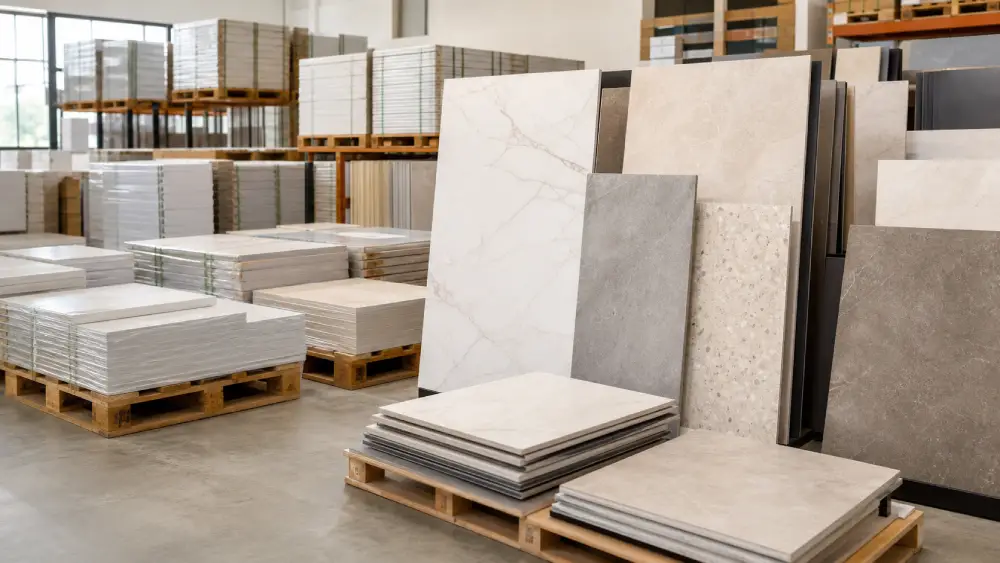
| Premium porcelain slab | Approximately 120×240 cm | $18.00–$35.00/m² |
Turkey’s national export unit value provides a useful sense check, not a product price list. Reported ceramic covering-material exports averaged $7.50 per m² across 2025 and $7.90 per m² in January–March 2026. An individual offer can legitimately sit below or above that average because the national figure blends markets, manufacturers, formats, qualities, and contract terms. Use the range to qualify a budget, then review actual models in TPI’s ceramic tile catalog. Availability, batch, technical data, and export packing must be confirmed before any commercial commitment.
How Do Ceramic, Porcelain, and Tile Format Change the Price?
Ceramic wall tile is usually the lowest-cost option, while dense porcelain, large formats, and slabs cost more to manufacture, handle, and pack. A useful comparison begins with application and body type, then narrows size, surface, and performance. Standard glazed ceramic suits many residential walls, kitchens, and bathroom surfaces where low water absorption and heavy traffic are not the primary requirements. Ceramic floor products need a body and surface suitable for foot traffic, so their production and testing requirements can move the price upward. Porcelain is fired to achieve a denser body and lower water absorption; it is often selected for commercial floors, demanding wet areas, exterior applications, or projects requiring a premium finish. Format changes both factory yield and logistics. A common modular tile can move through production, sorting, boxing, and palletizing efficiently. A 60×120 cm product requires more careful handling, stronger cartons, and tighter control of flatness. A thin porcelain slab needs specialist handling and may require a crate or frame rather than ordinary tile cartons. Breakage risk and loading geometry matter as much as the factory price. A porcelain tile wholesale price is useful only when the format and packing match. Do not compare a $5 wall tile with a $10 rectified porcelain tile as if one supplier were simply twice as expensive. Compare items by intended use, dimensions, thickness, water absorption, finish, edge treatment, shade, caliber, and packing. TPI’s bulk ceramic tile sourcing guide explains the specification and supplier-control steps that sit behind a reliable price.
Which Technical Specifications Increase Tile Cost?
Rectification, premium surfaces, demanding slip ratings, tighter sorting, special patterns, and stronger export packing can all increase tile cost per m2. Buyers should pay for performance the project needs, but avoid premium specifications that add no commercial value. A rectified edge requires an additional finishing stage and allows narrower, more consistent grout joints. Polished, lappato, structured, anti-slip, and special-effect surfaces use different processes and may require extra quality control. Wood-look planks and highly varied marble effects can also require more faces and stricter visual selection. For tendered work, requested test reports or destination-specific documentation may add administrative or testing cost. Shade and caliber control deserve special attention in repeat developments. A low offer loses its advantage if several towers receive visibly different batches or if replacement cartons cannot match the installed floor. State whether one batch is required, how much replacement stock should be supplied, and whether mixed designs are acceptable. Ask how seconds, commercial grade, and first quality are defined; those labels are not a substitute for agreed acceptance criteria.
Packaging also has a unit cost and a risk value. Confirm square meters and pieces per box, gross box weight, boxes per pallet, pallet dimensions, corner protection, wrapping, labels, and maximum stacking. Use the ceramic tile calculator to estimate project quantity, including waste, before requesting a commercial offer.
What Is the Difference Between EXW, FOB, and CIF Tile Prices?
EXW covers goods made available at the named factory, FOB covers delivery and export loading to the named Turkish port, and CIF adds sea freight plus minimum marine insurance to the named destination port. None of these terms automatically equals the final cost in your warehouse. An EXW number may exclude factory collection, inland haulage, terminal handling, export clearance, documentation, and port delivery. It can be useful when the buyer controls a Turkish logistics network, but it is not directly comparable with an FOB offer. A proper FOB quote should name the port and clearly identify included origin charges. For tiles, the load plan also needs to respect both container payload and safe weight distribution. CIF adds ocean transport and insurance, yet the buyer can still face destination terminal charges, customs clearance, duty, import VAT or other taxes, inspection, storage, demurrage, local delivery, and bank costs. The relevant rules depend on the destination country and tariff treatment. Ask the supplier to state the Incoterm version, named place, shipment window, free time, and exact exclusions. Currency and timing matter too. A quote in dollars is exposed to changes in freight, energy, and exchange rates until its validity and booking conditions are fixed. A professional comparison sheet should therefore show product value, origin logistics, ocean freight, insurance, destination costs, taxes, and inland delivery as separate lines.
How Do You Calculate Landed Cost Per Square Meter?
Calculate landed cost per square meter by dividing every cost required to place usable tiles at the agreed destination by the saleable square meters received. Keep recoverable taxes separate if your accounting treatment permits recovery, and include a realistic breakage or reserve allowance.
Formula: Landed cost per m² = (tile value + origin charges + freight + insurance + duty + nonrecoverable taxes + destination charges + inland delivery) ÷ usable delivered m².
Consider an illustrative container tile order of 1,300 m² priced at $8.00 per m² FOB. Product value is $10,400. Assume ocean freight and insurance of $3,200, destination and clearance charges of $1,050, broker-confirmed import duty of $1,040 for the named destination and HS code, and inland delivery of $600. The cash cost before any recoverable tax is $16,290. If the buyer budgets 2% for breakage and site reserve, usable quantity is 1,274 m². The planning result is $16,290 ÷ 1,274 = $12.79 per usable m².
This worked example is arithmetic, not a freight or customs quote. Actual duty, taxes, port charges, payload, and shipping cost must be checked for the buyer’s destination and shipment date. Even the loading quantity changes with tile thickness and carton weight. TPI’s tile box and pallet calculator helps turn the required area into estimated cartons, pallets, and gross weight before the load plan is confirmed.
What Should You Send for a Comparable Wholesale Tile RFQ?
A comparable RFQ must define the product, area, quantity, packing, delivery basis, and destination in one written schedule. The more precise the input, the less room there is for suppliers to price different products under similar names.
Send the following information:
- Project, country, destination port, and required delivery window.
- Ceramic or porcelain body, intended wall or floor application, and indoor or outdoor use.
- Size, thickness, finish, color, rectified or non-rectified edge, slip requirement, and quality grade.
- Required area by model, waste percentage, replacement stock, and acceptable MOQ.
- Requested Incoterm and named place, plus whether you need one model or mixed-container loading.
- Required standards, test reports, labels, pallet rules, inspection, and documents.
- Requested quote validity, production lead time, payment terms, and sample approval process.
Ask every bidder to return price per m², pieces and square meters per carton, carton and pallet weights, estimated container capacity, origin charges, exclusions, and lead time. Then compare the landed cost per square meter and the commercial risk, not merely the FOB tile price Turkey suppliers place at the top of a quote.
Prepare the schedule now, attach reference images or technical sheets, and identify the port where you want responsibility to transfer. Request a Quote.
Useful for your buying team?
Share or save this guide before the next supplier comparison.