TL;DR: A defined bathroom package using TPI’s public component prices costs €280: €153 for a vanity with ceramic sink and mirror, €44 for a faucet, €38 for a shower mixer, and €45 for a rain shower set. This is a dated public-list example, not a binding wholesale…
TL;DR: A defined bathroom package using TPI’s public component prices costs €280: €153 for a vanity with ceramic sink and mirror, €44 for a faucet, €38 for a shower mixer, and €45 for a rain shower set. This is a dated public-list example, not a binding wholesale quotation or a complete bathroom fit out cost; it excludes a WC, shower enclosure, installation, freight, duty, taxes, and destination charges. Bulk buyers need a line-by-line RFQ to confirm scope, quantity pricing, Incoterm, packing, and landed cost. “One bathroom” sounds like a standard purchasing unit, but two suppliers can use the phrase for completely different scopes. The safest commercial decision is to define every component first, then compare the per bathroom cost on the same delivery basis.
What Is the Example Wholesale Bathroom Package Price?
The defined four-item package totals €280 at the public prices verified on July 12, 2026. It provides a transparent starting point for budgeting a vanity, basin, faucet, shower control, and shower outlet, but it is not a complete bathroom or a volume discount schedule.
| Component | Included scope | Public reference price |
|---|---|---|
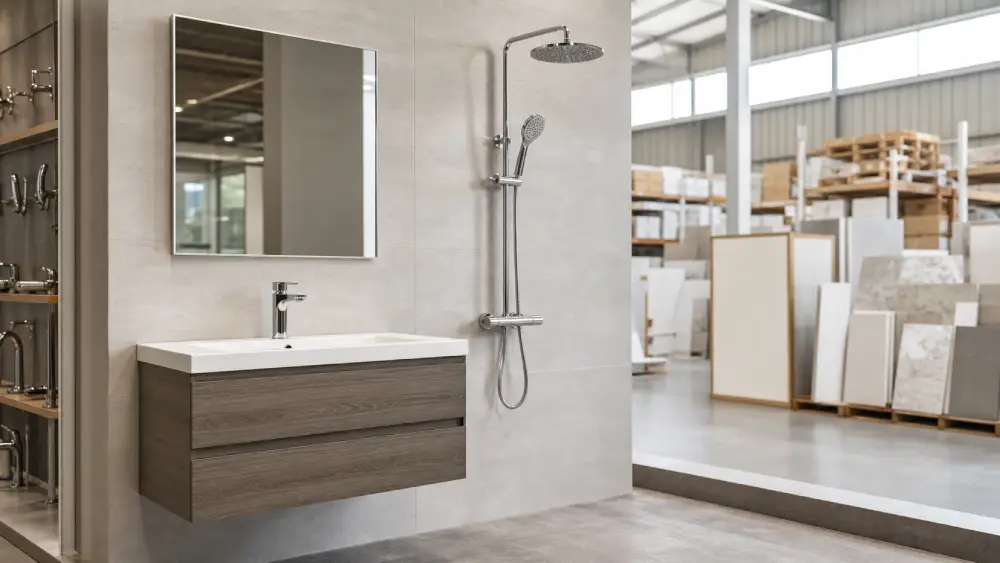
| Bathroom furniture set | Vanity cabinet, ceramic sink, and mirror | €153 |
| Single-head faucet | One basin faucet | €44 |
| Shower mixer | One shower battery/mixer | €38 |
| Rain shower set | One black rain shower set | €45 |
| Defined package total | €280 | |
The arithmetic is €153 + €44 + €38 + €45 = €280 per defined set. For 50 identical bathrooms, the catalog-value reference would be €14,000 before any volume negotiation or other cost. For 100, it would be €28,000. Do not assume these public reference prices include export packing, factory collection, freight, or any particular Incoterm; those details need written confirmation. Buyers can review cabinet and basin formats in TPI’s bathroom furniture range. Final price may change with model, dimensions, finish, quantity, availability, accessories, and packaging.
What Is Included—and Excluded—from This Bathroom Package?
The €280 example includes only the four listed sale items and the components expressly named with them. It excludes the sanitaryware, enclosure, concealed systems, plumbing materials, installation, logistics, and local charges required to deliver a functioning bathroom. The furniture line includes a vanity cabinet, ceramic sink, and mirror as one set. The package then adds one basin faucet, one shower mixer, and one black rain shower set. Buyers should still confirm whether wastes, traps, flexible connectors, fixing kits, hoses, hand showers, rails, mounting brackets, and spare cartridges come with the selected models. Product names do not guarantee every installation accessory. The example does not include a WC pan or cistern, WC seat, bidet, concealed frame, flush plate, shower enclosure, shower tray, floor drain, bathtub, water heater, bathroom tiles, lighting, ventilation, towel accessories, or plumbing pipework. It also excludes labor, waterproofing, electrical work, installation consumables, testing, and site supervision. Buyers building a full sanitary schedule can review TPI’s sanitaryware category without treating those additional products as part of the €280 total. This scope discipline prevents a common tender error. A supplier quoting only visible fixtures can appear cheaper than one pricing the WC, enclosure, traps, valves, and installation accessories. Put each required line in a bill of quantities, show whether it is included, excluded, or optional, and require bidders to identify deviations. That turns an ambiguous bathroom package cost into a comparable commercial schedule.
How Does Each Component Affect the Per-Bathroom Cost?
The vanity set is the largest cost in this example at €153, or about 55% of the €280 component total. The faucet, mixer, and rain shower together account for €127, so plumbing finishes and specifications can still move the package price materially. Cabinet pricing changes with width, board specification, moisture resistance, surface finish, drawer and door count, hardware, soft-close systems, basin type, mirror design, and assembly level. A compact standard model normally packs more efficiently than a wide, assembled unit with a fragile mirror. Confirm whether the cabinet arrives assembled or flat-packed, how the basin and mirror are protected, and how many complete sets fit safely on a pallet or in a container. Faucet and mixer prices depend on body material, cartridge, aerator, coating, hose and connector quality, finish, flow performance, warranty, and required approvals. Chrome is often the simplest finish to standardize. Matte black, brushed colors, or special PVD-style finishes may add cost and make batch consistency more important. Ask whether spare cartridges, aerators, hoses, and finish-matched parts can be ordered with the initial shipment. A rain shower set should be defined by head size, column material, hand-shower inclusion, hose, diverter, connection size, finish, and compatible pressure range. A low sanitary ware price is not a saving if the fitting thread, pressure performance, or spare-part strategy does not suit the destination market. When buying bathroom fixtures bulk, technical compatibility is part of the price comparison—not an afterthought.
Which Quality, Finish, and Quantity Choices Change Package Pricing?
Standardized models, finishes, and repeated quantities usually create a more controllable package price, while custom sizes, premium coatings, mixed designs, and small batches generally raise cost. The commercial goal is to standardize what users will not value and specify tightly what affects durability. Start with the project segment. Entry-level rental housing, mid-market apartments, hotels, hospitals, and premium villas have different expectations for cabinet life, water efficiency, repair access, visual finish, and warranty. Choose the performance level before asking for price. Otherwise, bidders may quote different board densities, hardware, brass content, cartridges, coatings, or ceramics under similar descriptions. Quantity affects factory setup, carton printing, model allocation, consolidation, and inspection cost. One hundred identical packages can be easier to source and pack than one hundred packages split across ten cabinet colors and five faucet finishes. However, a large order does not automatically earn a discount: customized production, slow-moving colors, small line quantities, or urgent delivery can reduce the benefit of volume.
Replacement planning also belongs in the budget. A multi-unit project should decide whether to purchase complete spare sets or only vulnerable and serviceable parts. Extra mirrors, cartridges, hoses, handles, hinges, and soft-close hardware may protect operations at a lower cost than emergency air shipments later. Use TPI’s bathroom package quantity estimator to organize unit counts before asking suppliers to confirm packing and MOQ.
How Do EXW, FOB, CIF, and Landed Costs Change the Total?
EXW, FOB, and CIF prices cover different portions of the supply chain, and only a landed calculation reveals the amount required to place each usable package at its destination. The €280 public example has no stated Incoterm, so it must not be labeled EXW, FOB, CIF, or delivered without a formal offer. EXW normally makes the goods available at the named premises, leaving collection, export handling, and most transport risk with the buyer. FOB includes delivery and export loading at a named Turkish port. CIF adds ocean freight and minimum marine insurance to a named destination port, but it generally does not include destination terminal charges, customs clearance, duty, import taxes, storage, demurrage, or inland delivery.
Formula: Landed cost per bathroom = (goods + origin logistics + export packing + freight + insurance + duty + nonrecoverable taxes + destination charges + inland delivery) ÷ usable complete packages.
For a worked illustration, assume a written supplier quote confirms 100 defined packages at €280 each FOB, making the goods value €28,000. Add €3,800 for ocean freight and insurance, creating an illustrative CIF value of €31,800. For the named HS codes and destination, assume the buyer’s licensed customs broker confirms €3,180 in duty and nonrecoverable import charges. Add €1,100 in destination and clearance charges plus €700 inland delivery. Total planning cost becomes €36,780, or €367.80 per package before installation and any recoverable tax.
Those freight, duty, and local-charge inputs are hypothetical arithmetic, not a quote or a tariff statement. Confirm commodity classification, customs value, tax treatment, destination fees, container load, insurance cover, and shipment date with qualified parties. Breakage or incomplete sets can also reduce the usable denominator, increasing the real per bathroom cost.
What Should You Send for an Accurate Per-Bathroom RFQ?
An accurate package RFQ should include a room-by-room bill of quantities, technical specifications, model references, quantities, destination, and required delivery term. One schedule should make every bidder price the same scope and clearly mark every exclusion.
Send the following information:
- Project type, destination country and port, number of bathrooms, and delivery window.
- Vanity width, material, color, basin type, mirror dimensions, hardware, and assembly preference.
- Faucet, mixer, and shower specifications, including material, cartridge, finish, pressure, flow, and connection sizes.
- Every required WC, enclosure, drain, trap, valve, accessory, fixing kit, connector, and spare part.
- Acceptable models, sample and finish approval process, required test documents, labeling, and warranty expectations.
- Requested Incoterm and named place, plus separate origin, freight, insurance, and optional delivery lines.
- MOQ by item, quote validity, payment terms, production lead time, packing details, and estimated container quantity.
Ask for unit price and extended price on every line, then reconcile the number of complete sets. TPI’s wholesale plumbing buyer’s guide can help procurement teams define fittings, certificates, spares, and packing before comparing offers.
Complete the schedule now and state which optional products—especially the WC and shower enclosure—must be priced separately. Request a Quote.
Useful for your buying team?
Share or save this guide before the next supplier comparison.