TL;DR: Wholesale buyers can buy tiles online safely when they treat the process like a structured import order: define tile specs, compare supplier quotes line by line, request samples from the same production range, confirm packaging and documents, and calculate landed cost before paying. This guide…
TL;DR: Wholesale buyers can buy tiles online safely when they treat the process like a structured import order: define tile specs, compare supplier quotes line by line, request samples from the same production range, confirm packaging and documents, and calculate landed cost before paying. This guide explains how to source wholesale tiles online, reduce mistakes in a bulk tile order, and avoid suppliers that cannot support repeat B2B purchasing.
Start With A Clear Tile Buying Brief
Online tile buying becomes risky when the buyer only sends a photo and asks for a price. A serious supplier needs a short but complete buying brief. The brief should make the product, quantity, quality level, destination, and timeline clear enough for a comparable quote.
- Tile type: ceramic, porcelain, wall tile, floor tile, outdoor tile, or decorative tile.
- Size and thickness: for example 30×60 cm, 60×60 cm, 60×120 cm, or project-specific dimensions.
- Finish: matt, glossy, polished, textured, anti-slip, or structured.
- Application: bathroom wall, bathroom floor, commercial lobby, kitchen, hotel room, or residential unit.
- Quantity: square meters, number of boxes, project phase, and expected repeat order volume.
- Destination: delivery port, inland delivery point, and required Incoterms.
If your project is still at product selection stage, review TPI’s wholesale ceramic tile options before building the RFQ list.
Choose The Right Tile Type Before Comparing Prices
The cheapest quote is not always comparable. A ceramic wall tile, porcelain floor tile, and anti-slip outdoor tile can all look similar in a small image, but they perform differently in real projects. Before you buy tiles online, decide which product type fits the application.
| Tile Type | Best Use | What To Check |
|---|---|---|
| Ceramic wall tile | Bathroom walls, kitchens, light-use interiors | Glaze quality, flatness, color consistency, carton protection |
| Ceramic floor tile | Residential floors and moderate traffic areas | Breaking strength, water absorption, surface wear, slip level |
| Porcelain tile | High-traffic floors, commercial areas, outdoor-rated spaces | Density, thickness, rectification, anti-slip rating if needed |
| Decorative tile | Accent walls, hotel bathrooms, retail interiors | Pattern matching, batch control, shade variation, replacement availability |
Request Samples From The Actual Production Range
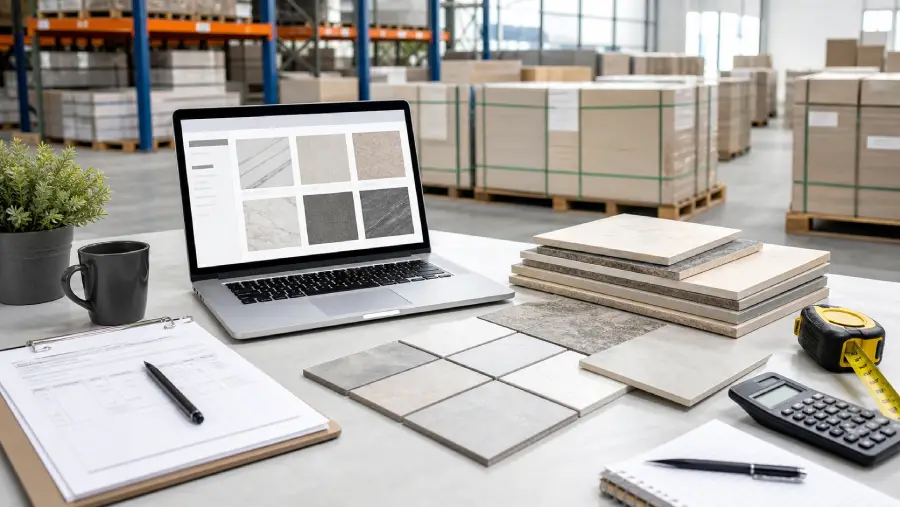
Samples are useful only when they represent the production batch or range that will be supplied. A sample from an old catalog, showroom display, or different factory line does not protect the buyer. Ask the supplier to label each sample with product code, size, finish, production date if available, and packing details.
- Compare shade, gloss, and texture under natural and artificial light.
- Check edges and corners for chips, warping, and visible defects.
- Confirm whether the final shipment may include shade or caliber variation.
- Ask how many spare cartons should be ordered for future maintenance.
For deeper supplier-side checks, the existing ceramic tile supplier guide can be used as the supporting sourcing checklist.
Compare Supplier Quotes Line By Line
A good online tile quote should be easy to audit. It should not hide packaging, palletization, port charges, sample cost, or replacement rules. Ask each supplier to quote in the same structure so your procurement team can compare the real cost.
- Confirm product code, size, finish, and intended use.
- Ask for unit price per square meter and carton coverage.
- Confirm minimum order quantity and mixed-model allowance.
- Ask whether pallets, shrink wrap, edge protection, and labels are included.
- Clarify Incoterms such as EXW, FOB, CFR, or CIF.
- Request estimated carton count, pallet count, gross weight, and container fit.
- Confirm payment terms, lead time, and document availability.
If the order includes several product families, use TPI’s construction materials sourcing guide to plan a more efficient bundled shipment.
Plan MOQ, Container Loading And Landed Cost
A bulk tile order should be judged by landed cost, not only factory price. The landed cost includes tile price, inland transport, export handling, sea freight, insurance if applicable, import duty, local port charges, inland delivery, and breakage allowance. A lower unit price can become expensive if the order ships half-empty or needs excessive handling.
- Use full-pallet quantities where possible to reduce handling damage.
- Group compatible sizes and finishes to fill container space efficiently.
- Keep spare quantities for repairs, especially for projects with phased installation.
- Ask whether mixed models can be loaded without increasing lead time.
- Calculate cost per delivered square meter, not only cost per quoted square meter.
Check Export Documents Before Payment
Document readiness matters as much as product readiness. Before deposit or balance payment, confirm which documents the supplier can provide and whether your customs broker needs specific wording.
- Commercial invoice and packing list.
- Bill of lading or transport document.
- Certificate of origin when required.
- Product specification sheet or test report where available.
- HS code guidance, with final classification confirmed by the buyer’s customs broker.
For import workflow details, use this guide on how to import construction materials from Turkey.
Red Flags When Buying Tiles Online
The main risk in online sourcing is not the platform itself. The risk is buying from a supplier that cannot control specs, documents, packaging, or after-sales support. Avoid suppliers that refuse basic RFQ questions or push for payment before confirming technical details.
- No product code, no carton details, or no batch/shade policy.
- Only lifestyle photos, with no close-up surface or edge images.
- Unclear MOQ and changing prices after sample approval.
- No written packaging specification for export shipment.
- No realistic lead time or document timeline.
- Very low price with no explanation of grade, finish, or stock source.
Wholesale Buyer Checklist
Before placing the order, your procurement file should be complete enough for another team member to review without asking basic questions.
- Final tile codes, dimensions, finish, and application are approved.
- Samples are checked and matched to the quoted product range.
- MOQ, carton coverage, pallet count, and container estimate are confirmed.
- Incoterms, payment schedule, lead time, and documents are written in the quote.
- Breakage allowance and spare quantity are included in the order plan.
- Buyer has confirmed import duties and local requirements with a customs broker.
When the product list is ready, send the RFQ through the request a wholesale quote page.
FAQ
Is it safe to buy tiles online for a wholesale project?
Yes, if the order is handled like a formal procurement process. Use product codes, samples, written specs, packaging details, and landed-cost calculations instead of relying only on website photos.
What is the minimum order quantity for wholesale tiles?
MOQ depends on the supplier, tile model, production status, and whether the buyer mixes models. Full-pallet and container-based orders usually give better pricing and safer loading.
Should I request samples before a bulk tile order?
Yes. Samples help check color, finish, thickness, edge quality, and surface texture. They should be tied to the quoted product code and current production range.
How do I compare ceramic and porcelain tiles online?
Compare intended use, water absorption, strength, surface wear, slip rating, thickness, finish, and price per delivered square meter. Porcelain is usually better for demanding floors, while ceramic can be efficient for many wall and residential uses.
What information should be in a tile supplier quote?
The quote should include product code, size, finish, price, MOQ, carton coverage, pallet count, Incoterms, lead time, payment terms, packaging details, and available export documents.
How much extra tile should wholesale buyers order?
Many projects add a spare allowance for cuts, breakage, and future repairs. The exact percentage depends on layout complexity, tile size, installation pattern, and whether replacement stock will remain available.
Can different tile models ship in one container?
Often yes, but the supplier must confirm pallet planning, carton weights, loading sequence, and mixed-model MOQ. Mixed loads should be planned carefully to reduce breakage and unloading errors.
What is the biggest mistake when buying tiles online?
The biggest mistake is comparing only the visible unit price. A buyer should compare total landed cost, product grade, packaging quality, lead time, and supplier reliability.
Do online tile buyers need a customs broker?
For import orders, a customs broker is strongly recommended. The broker can confirm HS classification, duties, taxes, local documents, and port requirements before shipment.
Useful for your buying team?
Share or save this guide before the next supplier comparison.