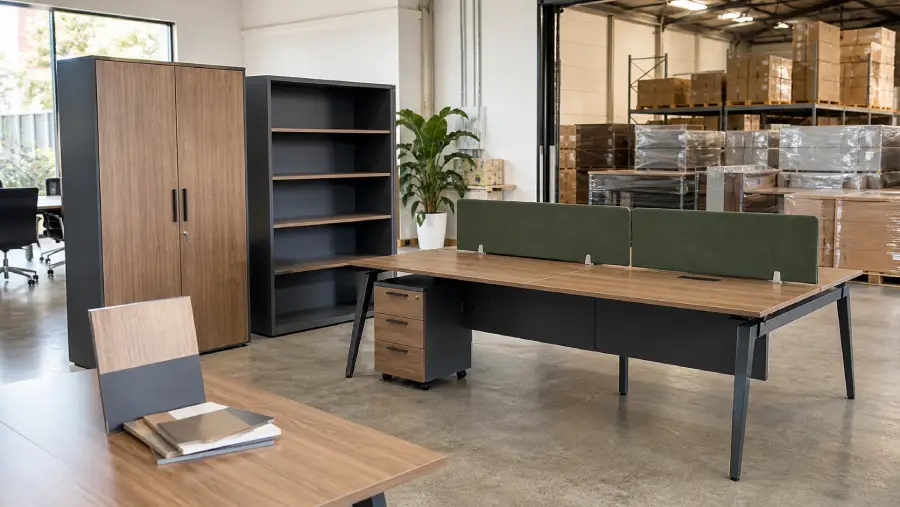
TL;DR: Source office furniture from an approved room and furniture schedule that lists desk sizes, storage units, finishes, hardware, cable-management needs, quantities and installation scope. Compare suppliers using the same material build-up, dimensions, accessories and delivery condition. Approve drawings, material samples and one representative assembled set…
TL;DR: Source office furniture from an approved room and furniture schedule that lists desk sizes, storage units, finishes, hardware, cable-management needs, quantities and installation scope. Compare suppliers using the same material build-up, dimensions, accessories and delivery condition. Approve drawings, material samples and one representative assembled set before production. For export orders, confirm knock-down packaging, carton references, spare hardware, container volume and the process for replacing damaged panels. TPI’s office furniture product category can help buyers define coordinated desk, cabinet and bookcase requirements.
Create a Furniture Schedule Before Requesting Prices
A total such as “50 office sets” does not define what the project needs. Prepare a schedule by room type and user group. Give every desk, return, pedestal, cabinet, bookcase and meeting element a unique reference. State whether quantities represent individual units or complete sets, and connect each reference to a layout or dimensioned drawing.
The schedule should also identify installation location, floor, finish family, cable access and any lock or storage configuration. Where several rooms repeat, create a standard room package and show exceptions separately. This lets the supplier calculate panel usage, hardware, packing and installation time without making assumptions.
- Furniture reference and quantity
- Overall dimensions and orientation
- Panel, frame, edge and surface specification
- Drawers, doors, shelves and locking requirements
- Cable-management and power-access provisions
- Finish, color and sample approval
- Flat-pack, assembled or installation scope
Compare Desks, Cabinets and Project Sets
| Product group | Key RFQ information | Common procurement risk |
|---|---|---|
| Work desk | Top size, frame, modesty panel and cable access | Missing accessories or unstable dimensions |
| Executive desk set | Main desk, return, cabinet and matching pieces | Comparing incomplete sets as equal offers |
| Mobile or fixed pedestal | Drawer layout, lock, runners and castors | Wrong height or keying arrangement |
| Storage cabinet | Width, height, shelves, doors and load intent | Insufficient shelf support or anchoring plan |
| Bookcase or display unit | Open/closed sections, backing and fixing | Damage during transport or unsafe installation |
Ask for an itemized quotation even when the design is sold as a coordinated set. The buyer should know which pieces, accessories and hardware are included and how each unit is packed. This makes substitutions, replacements and quantity checks manageable.
Specify Panels, Edges, Frames and Surfaces
Office furniture suppliers should describe the actual material build-up behind a visual finish. Request panel type, thickness, surface treatment, edge material and thickness, frame material, backing panels and relevant adhesives or connectors. A color name does not describe durability, cleanability or structural construction.
High-contact edges and corners need particular attention. Review edge continuity, joints, exposed substrate, corner treatment and the finish around cut-outs. For metal frames, confirm section, finish, weld appearance, adjustable feet and floor-contact details. Project requirements for emissions, fire behavior or other performance must come from the consultant or destination rules and be included explicitly in the RFQ.
Check Dimensions, Ergonomics and Layout Compatibility
Furniture dimensions must fit the approved space and planned circulation. Confirm desk height, worktop depth, knee space, drawer clearance, cabinet door swing and access to wall or floor services. Do not rely on a catalog image to prove that a set fits the room.
Ask for dimensioned shop drawings and place the proposed units on the project layout before approval. If monitors, equipment or shared workstations are planned, identify their space and cable routes. Accessibility and ergonomic requirements vary by project and market, so the responsible designer should approve the final dimensions.
Approve Colors, Materials and a Complete Sample Set
Digital images are useful for selection but not final finish approval. Request physical samples of panels, edges, metal finishes, handles and other visible materials. Label the approved sample with the supplier code and revision. Check the combination under lighting similar to the finished office.
For repeated orders, approve one representative assembled desk and storage unit. Review dimensions, alignment, gaps, edge application, drawer operation, locks, stability, cable openings and visible fasteners. Record corrections in writing and require an updated approval where the sample changes. A small finish chip alone cannot reveal assembly quality.
Review Hardware, Assembly and Installation Responsibility
List hinges, runners, locks, handles, connectors, adjustable feet and cable accessories by reference. Ask whether replacement hardware is standard or model-specific. Where multiple locks are used, state whether units need unique keys, keyed-alike groups or a master-key arrangement.
Clarify whether furniture ships assembled, partly assembled or flat-packed. The supplier should provide assembly drawings and identify tools, fixings and wall-anchoring parts. Define who checks site dimensions, carries cartons to floors, assembles units, removes packaging and corrects installation defects. TPI’s construction-materials supplier guide explains how to divide scope clearly across project suppliers.
Compare Capacity, MOQ, Pricing and Logistics
Bulk office furniture can involve many references but repeated materials. Ask whether MOQ applies per model, finish, panel batch or total order. Request separate timelines for drawings, samples, material procurement, production, inspection and dispatch. Check whether the supplier can hold approved finishes consistently across phased deliveries.
Compare itemized prices on the same Incoterm and scope. Include drawings, samples, spare hardware, packaging, pallet or rack costs, inland transport, inspection, freight and installation where required. The guide to importing construction materials from Turkey provides the wider document sequence.
Furniture is volume-sensitive cargo. Request carton dimensions, units per carton, gross weights and total CBM before accepting the freight estimate. Efficient knock-down packing can reduce volume, but it must still protect panels, edges, glass and hardware. TPI’s logistics services can support planning for consolidated project shipments.
Office Furniture RFQ Checklist
- Attach layouts, room packages and the furniture schedule.
- List each desk, cabinet, pedestal and bookcase separately.
- Define dimensions, orientation, materials, edges and finishes.
- Specify drawers, locks, shelves and cable-management parts.
- Request dimensioned drawings and physical finish samples.
- Approve one representative assembled set before production.
- Confirm flat-pack, assembly and installation responsibilities.
- Request carton quantities, dimensions, weights and total CBM.
- Fix MOQ, lead time, Incoterm, validity and payment terms.
- Define inspection, spare parts and damage-replacement procedures.
Frequently Asked Questions
What information do office furniture suppliers need?
They need layouts, a furniture schedule, dimensions, quantities, material and finish requirements, hardware, delivery condition, destination and installation scope.
What is the MOQ for wholesale office furniture?
MOQ can apply by model, finish, material batch or total project value. Ask which elements create a separate minimum and whether coordinated pieces can be combined.
Should buyers request an assembled sample?
Yes for repeated project items. An assembled sample exposes dimension, stability, hardware, alignment and finish issues that material chips cannot show.
What should an office furniture set include?
There is no universal set. Require an itemized list covering the desk, return, pedestal, cabinet, bookcase, coffee table or other pieces included in the quotation.
Is flat-pack furniture better for export?
It can reduce shipping volume, but only when parts are well protected, labeled and supported by clear assembly instructions. Compare damage and installation risk as well as freight.
How should finish colors be approved?
Use labeled physical samples for panels, edges, metals and handles. Keep an approved control sample and reference the same codes in drawings and purchase orders.
How can buyers reduce missing-hardware problems?
Require a bill of hardware, sealed labeled kits, spare quantities and carton-level checks. Keep accessories connected to each furniture reference.
How is container volume calculated?
Use final carton dimensions and quantities for every reference. Add pallet or rack dimensions where applicable instead of estimating from assembled furniture size.
Who should approve office furniture dimensions?
The project designer or responsible buyer should confirm layout, circulation, equipment, ergonomic and accessibility requirements before production drawings are released.
How can a buyer request an office furniture quotation?
Send layouts, schedules, finish requirements, quantities, destination and target delivery through TPI’s project sourcing contact page.
Useful for your buying team?
Share or save this guide before the next supplier comparison.