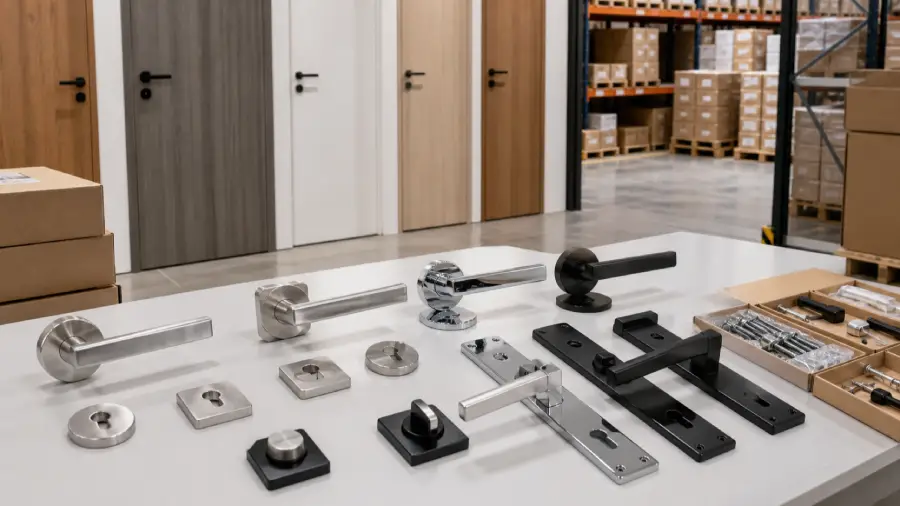
TL;DR: A handle order must be tied to the door schedule: interior or exterior use, lock type, door leaf thickness, spindle, centre distances, rose or backplate, finish, accessories and quantity per reference. Ask for a complete kit and a fitted sample before approving production. Check compatibility…
Link Each Handle to the Door Schedule
The choice of a handle must not be separated from the door, the lock and the use of the room. Assign a hardware reference to each door type: bedroom, bathroom, office, entrance, technical room or special exit. The schedule must state the number of door leaves and the number of kits required, without confusing the number of doors with the number of visible handles.
State the door leaf thickness, the door material, the lock type, the presence of a cylinder, the opening direction when the model is not reversible, and the usage constraints. An exterior door, a light interior door and a door subject to a specific requirement should not automatically receive the same set.
- Reference and quantity of each door type
- Interior, exterior, residential or communal use
- Thickness and material of the door leaf
- Lock type, cylinder and locking function
- Handle format, rose or backplate
- Finish, colour and matching accessories
- Performance requirements set in the specification
Choosing Between Rose, Backplate and Other Configurations
| Configuration | Items to specify | Risk to avoid |
|---|---|---|
| Lever on rose | Shape, diameter or dimensions, spindle and escutcheon | Ordering the handle without a matching lock accessory |
| Lever on backplate | Length, width, centre distance and cut-out | Incompatibility with the lock or cylinder |
| Pull handle | Length, fixing centre distance and mounting | Fixings unsuited to the door leaf |
| Bathroom kit | Locking, emergency external release and accessories | Mixing functions between bedrooms and bathrooms |
| Exterior set | Exposure, fixing, lock and protection level | Using an interior finish in an aggressive environment |
Ask for a bill of materials for the kit, not just a photo. It must specify the levers, roses or backplates, spindle, screws, fixings, escutcheon, locking and any additional part. Two visually similar models can be delivered with different components.
Checking Material, Finish and Environment
The base material, the surface treatment and the environment of use influence visual and functional durability. Ask the supplier to identify the exact material and finish, for example chrome, black, brushed or two-tone appearance, without relying on the marketing name of the colour. Coastal, humid, heavily cleaned or high-traffic areas may require more demanding criteria.
For wholesale door handles, consistency between batches is as important as the initial sample. Define the colour and texture approval method, then keep a reference sample. Check variations under the same lighting and on parts from several cartons, not just on a unit prepared for presentation.
Checking Compatibility with Lock, Spindle and Door Leaf
Before ordering, provide the lock datasheet or a representative physical set. Confirm the spindle dimensions, centre distances, cylinder or key position, permissible door thickness, length of through screws and spring system. A difference of a few functional dimensions can prevent installation across the whole project.
Request a fitting test including the door or a mock-up of equivalent thickness, the lock, the cylinder and the accessories. Check the lever return, play, alignment, tightening and access to the screws. To coordinate the full package, the TPI guide on wholesale doors for projects helps distinguish the requirements of steel, PVC and WPC doors.
Defining Durability and Safety Checks
The specification must state the tests or evidence expected according to the use and the market. Checks may cover mechanism endurance, finish durability, corrosion, fixing strength or other contractual performance. Request documents corresponding to the proposed model and configuration.
A handle intended for a fire door, an exit, a security door or another regulated assembly must not be selected as an isolated decorative accessory. Compatibility must be assessed at the door assembly level and according to the project rules. The supplier must not present a result from another model as universal proof.
Approving a Sample and Controlling the Series
The sample must be a complete kit in its intended packaging. Fit it with a representative lock and door, then check the appearance, dimensions, grip, return, noise, fixings and accessories. Identify in writing the code, finish, revision and approved comments.
During pre-shipment inspection, check several cartons spread across the batch. Compare references, finish, contents, critical dimensions, operation and visual condition. Photograph the labels and the parts inspected. The sampling method and acceptance criteria must be agreed before production.
Comparing MOQ, Kit Composition and Price
The MOQ can vary by model, finish or type of accessory. Ask whether several finishes can share the minimum and whether escutcheons or locking functions have their own minimum quantity. Add a maintenance reserve per reference to avoid a small top-up order that is hard to reproduce.
To compare offers, use the cost of the complete delivered kit, not just that of a pair of levers. Include accessories, individual packaging, cartons, pallets, documents, transport and any inspection. The guide on wholesale Turkish door prices provides useful context for building the overall budget for the door and hardware package.
Preventing Scratches and Packaging Errors
Each kit must be separated to prevent contact between finished surfaces. Check the bags, protections, compartments, inner cartons and master cartons. Small screws and accessories must stay with the right model. A missing part can immobilise a door even if the main handle is intact.
Labels must show at least the reference, finish, quantity and the link to the door schedule. For large projects, ask for packing by building, floor or housing type. TPI also explains partner qualification and package coordination in its guide to importing building materials from Turkey.
RFQ Checklist for Door Handles
- Attach the door schedule and the hardware drawings.
- Identify the use, material and thickness of each door.
- Provide the references or dimensions of locks and cylinders.
- Choose rose, backplate, pull or special function.
- Define material, colour, finish and environment.
- Request the complete bill of materials for each kit.
- Arrange a fitted sample and its written approval.
- Specify tests, documents and pre-shipment inspection.
- Confirm MOQ, lead time, packaging and maintenance reserve.
- Set Incoterm, payment and non-conformity procedure.
Frequently Asked Questions
What is the MOQ for wholesale door handles?
It depends on the model, finish, packing and manufacturer. Ask for the minimum per reference and per finish, as well as the possibilities for combining.
Is a handle sold individually or as a kit?
Practices vary. The quote must specify each component: levers, roses or backplates, spindle, screws, escutcheon, locking and accessories.
How do I check compatibility with a lock?
Compare spindle, centre distances, cut-out, cylinder, door thickness and fixings. The safest check is to fit a complete kit with the intended lock.
Should I order a sample?
Yes. The sample lets you check finish, dimensions, kit contents, fitting and operation before launching the full quantity.
Which finish should I choose for an exterior door?
The choice depends on exposure, climate, cleaning and project requirements. Ask for durability information suited to the environment instead of choosing by colour alone.
Can the same handle be used on all doors?
Only if the functions, locks, thicknesses, uses and requirements are genuinely compatible. Bathrooms, entrances and technical rooms often need different configurations.
What documents should I request from the supplier?
Request datasheets, identification of materials and finishes, dimensional drawings and test evidence required by the specification or the target market.
How can I avoid colour differences between batches?
Approve a reference sample, use a precise finish code, limit unnecessary production splits and check several cartons under the same lighting.
How should handles be packed for export?
Use individual separation of surfaces, accessories kept with their kit, sturdy cartons, legible labels and palletising suited to the journey.
How do I request a quote for a project?
Send the door schedule, lock references, finishes, quantities, destination and schedule via the TPI Exports quote request page.
Useful for your buying team?
Share or save this guide before the next supplier comparison.